Home
Sharpe Ratio
Under CAPM, the market portfolio is the portfolio on the efficient frontier with the highest Sharpe ratio.
The slope of the capital market line equals the market (i.e. index) Sharpe ratio.
The Sharpe Ratio makes implicit assumptions which stem from CAPM. It assumes either 1) normally distributed returns or 2) mean-variance preferences.
Both assumptions are suspect:
1) The returns generated by most hedge funds exhibit negative skewness.
2) In addition to the mean and variance, people also care about skewness (they like it positive) and kurtosis (they don't like it), and higher moments matter too.
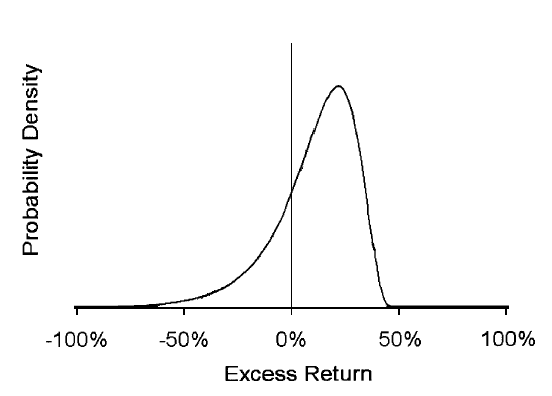
Because the Sharpe ratio is oblivious of all moments higher than the variance, it is prone to manipulation. Goetzmann, et al. (2004) proved that an optimal (high) Sharpe ratio strategy would produce a distribution with a truncated right tail and a fat left tail (see chart below).
That is, generate regular modest profits punctuated by occasional crashes, i.e. negative skewness.
As mentioned above, most investors prefer positive skewness, therefore, although a high Sharpe ratio is good thing, a high Sharpe ratio strategy is a bad thing.
An optimal Sharpe ratio strategy would be to sell high-priced, low probability payoffs, for example short out-of-the-money puts or short out-of-the-money calls.
Links
Bibliography
AGUDO, L.F. and J.L. MARZAL, 2004. An analysis of Spanish investment fund performance: some considerations concerning Sharpe's ratio . Omega(Oxford). [Cited by 8 ] (2.44/year)
AKEDA, Y., 2003. Another Interpretation of Negative Sharpe Ratio . Journal of Performance Measurement. [Cited by 5 ] (1.17/year)
ALEXANDER, G.J. and A.M. BAPTISTA, 2003. Portfolio performance evaluation using value at risk . The Journal of Portfolio Management. [Cited by 8 ] (1.87/year)
AMATO, J.D. and E.M. REMOLONA, 2005. The Pricing of Unexpected Credit Losses . papers.ssrn.com. [Cited by 13 ] (5.72/year)
ANDERSEN, T.G., T. BOLLERSLEV and A. DAS, 2001. Variance-ratio Statistics and High-frequency Data: Testing for Changes in Intraday Volatility … . The Journal of Finance. [Cited by 36 ] (5.74/year)
ANG, A. and G. BEKAERT, 2003. How do regimes affect asset allocation? . CFA Institute. [Cited by 34 ] (7.96/year)
BACKUS, D.K., A.W. GREGORY and C.I. TELMER, 1993. Accounting for Forward Rates in Markets for Foreign Currency . The Journal of Finance. [Cited by 91 ] (6.38/year)
BERNARDO, A.E. and O. LEDOIT, 2000. Gain, Loss and Asset Pricing . Journal of Political Economy. [Cited by 97 ] (13.34/year)
BIGLOVA, A., et al. , 2004. Comparison among different approaches for risk estimation in portfolio theory . Journal of Portfolio Management. [Cited by 15 ] (4.58/year)
BOLDRIN, M., L.J. CHRISTIANO and J.D.M. FISHER, 2001. Habit Persistence, Asset Returns, and the Business Cycle . The American Economic Review. [Cited by 237 ] (37.78/year)
BOSSAERTS, P., L. FINE and J. LEDYARD, 2002. Inducing liquidity in thin financial markets through combined-value trading mechanisms . European Economic Review. [Cited by 23 ] (4.36/year)
BRENNAN, M.J., 2001. Intertemporal Capital Asset Pricing and the Fama-French Three-Factor Model . [Cited by 20 ] (3.19/year)
BRENNAN, M.J., T. CHORDIA and A. SUBRAHMANYAM, 1998. Alternative factor specifications, security characteristics, and the cross-section of expected stock … . Journal of Financial Economics. [Cited by 277 ] (29.87/year)
BRITTEN-JONES, M., 1999. The Sampling Error in Estimates of Mean-Variance Efficient Portfolio Weights . The Journal of Finance. [Cited by 80 ] (9.67/year)
BROOKS, C. and H. KAT, 2002. The Statistical Properties of Hedge Fund Index Returns and Their Implications for Investors . Journal of Alternative Investments. [Cited by 78 ] (14.79/year)
BURKE, G., 1994. A Sharper Sharpe Ratio. Futures. [Cited by 3 ] (0.23/year)
CAMPBELL, J.Y., 1998. Asset prices, consumption, and the business cycle . elsevier.com. [Cited by 242 ] (26.10/year)
CAMPBELL, J.Y. and J.H. COCHRANE, 2000. Explaining the Poor Performance of Consumption-based Asset Pricing Models . The Journal of Finance. [Cited by 112 ] (15.40/year)
CAMPBELL, J.Y. and J.H. COCHRANE, 1999. By Force of Habit: A Consumption-Based Explanation of Aggregate Stock Market Behavior . Journal of Political Economy. [Cited by 961 ] (116.15/year)
CERN?, A., 2003. Generalised Sharpe Ratios and Asset Pricing in Incomplete Markets . European Finance Review. [Cited by 17 ] (3.98/year)
CHAN, Y.L. and L. KOGAN, 2002. Catching Up with the Joneses: Heterogeneous Preferences and the Dynamics of Asset Prices . Journal of Political Economy. [Cited by 70 ] (13.27/year)
CHAPMAN, D.A., 1998. Habit Formation and Aggregate Consumption . Econometrica. [Cited by 28 ] (3.02/year)
CHEN, S.S., C.F.E.W. LEE and K. SHRESTHA, 2001. Ona Mean-Generalized Semivariance Approach TO Determining THE Hedge Ratio . Journal of Futures Markets. [Cited by 8 ] (1.28/year)
CHENG, P. and Y. LIANG, 2000. Optimal diversification: Is it really worthwhile . Journal of Real Estate Portfolio Management. [Cited by 11 ] (1.51/year)
CHOEY, M. and A.S. WEIGEND, Nonlinear trading models through sharpe ratio maximization . www-psych.stanford.edu. [Cited by 17 ] (?/year)
CHRISTENSEN, M.M., 2005. Outperformance of sharpe ratio based strategies . [Cited by 3 ] (1.32/year)
CHRISTENSEN, M.M. and E. PLATEN, 2005. Sharpe ratio maximization and expected utility when asset prices are discontinuous. [Cited by 3 ] (1.32/year)
COCHRANE, J.H., 2001. Asset Pricing . books.google.com. [Cited by 1053 ] (167.85/year)
COOPER, M., R.C. GUTIERREZ and W. MARCUM, 2005. On the Predictability of Stock Returns in Real Time . Journal of Business. [Cited by 31 ] (13.64/year)
CULP, C.L., R. MENSINK and A.M.P. NEVES, 1999. Value at Risk for Asset Managers . Derivatives Quarterly. [Cited by 14 ] (1.69/year)
DACOROGNA, M.M., et al. , 1995. Heterogeneous real-time trading strategies in the foreign exchange market . The European Journal of Finance. [Cited by 28 ] (2.28/year)
DACOROGNA, M.M., et al. , 2001. Effective return, risk aversion and drawdowns . Physica A: Statistical Mechanics and its Applications. [Cited by 19 ] (3.03/year)
DE, A., F. DE and C. VELD, 1997. Out-of-sample hedging effectiveness of currency futures for alternative models and hedging … . Journal of Futures Markets. [Cited by 13 ] (1.27/year)
DEMPSTER, M.A.H., et al. , 2001. Computational learning techniques for intraday FX trading usingpopular technical indicators . Neural Networks, IEEE Transactions on. [Cited by 25 ] (3.99/year)
DOWD, K., 2000. Adjusting for Risk: An Improved Sharpe Ratio . International Review of Economics and Finance. [Cited by 32 ] (4.40/year)
ELTON, E.J., M.J. GRUBER and C.R. BLAKE, 2004. The Adequacy of Investment Choices Offered By 401K Plans . Journal of Public Economics. [Cited by 20 ] (6.11/year)
ELTON, E.J., M.J. GRUBER and J.C. RENTZLER, 1987. Professionally Managed, Publicly Traded Commodity Funds . The Journal of Business. [Cited by 44 ] (2.17/year)
FAMA, E.F. and K.R. FRENCH, 2002. The Equity Premium . The Journal of Finance. [Cited by 241 ] (45.70/year)
FAVRE, L. and J.A. GALEANO, 2002. Mean-Modified Value-at-Risk Optimization with Hedge Funds . Journal of Alternative Investments. [Cited by 33 ] (6.26/year)
FERNANDEZ-RODRIGUEZ, F., C. GONZALEZ-MARTEL and S. , 2000. On the Profitability of Technical Trading Rules Based on Artificial Neural Networks: Evidence from … . Economics Letters. [Cited by 37 ] (5.09/year)
FERRUZ, L. and J.L. SARTO, 2003. Some Reflections on the Sharpe Ratio and its Empirical Application to Fund Management in Spain. Advances in Investment Analysis and Portfolio Management. [Cited by 5 ] (1.17/year)
FERSON, W.E. and A.F. SIEGEL, Review of Financial Studies. Stochastic Discount Factor Bounds with Conditioning Information . [Cited by 25 ] (?/year)
FLEMING, J., C. KIRBY and B. OSTDIEK, 2001. The Economic Value of Volatility Timing . The Journal of Finance. [Cited by 101 ] (16.10/year)
FUNG, W. and D.A. HSIEH, 1999. Is Mean-Variance Analysis Applicable to Hedge Funds? . Economic Letters. [Cited by 36 ] (4.35/year)
GENCAY, R., 1998. Optimization of technical trading strategies and the profitability in security markets . Economics Letters. [Cited by 26 ] (2.80/year)
GLEN, J. and P. JORION, 1993. Currency Hedging for International Portfolios . The Journal of Finance. [Cited by 76 ] (5.32/year)
GOETZMANN, W.N., et al. , 2002. Sharpening Sharpe Ratios . [Cited by 55 ] (10.43/year)
GREGORIOU, G.N., 2004. Performance of Canadian Hedge Funds Using a Modified Sharpe Ratio. Derivatives Use, Trading & Regulation. [Cited by 3 ] (0.92/year)
GREGORIOU, G.N. and J.P. GUEYIE, 2003. Risk-Adjusted Performance of Funds of Hedge Funds Using a Modified Sharpe Ratio . Journal of Wealth Management. [Cited by 13 ] (3.04/year)
GROSSMAN, S.J. and Z. ZHOU, 1996. Equilibrium Analysis of Portfolio Insurance . The Journal of Finance. [Cited by 105 ] (9.31/year)
HELLSTROM, T., 2001. Optimizing the Sharpe Ratio for a Rank Based Trading System . Portuguese Conference on Artificial Intelligence. [Cited by 9 ] (1.43/year)
HELLSTROM, T. and K. HOLMSTROM, 1999. Parameter Tuning in Trading Algorithms using ASTA . Computational Finance. [Cited by 18 ] (2.18/year)
HENDERSON, V., 2005. ANALYTICAL COMPARISONS OF OPTION PRICES IN STOCHASTIC VOLATILITY MODELS . Mathematical Finance. [Cited by 12 ] (5.28/year)
HODGES, C.W., W.R.L. TAYLOR and J.A. YODER, 1997. Stocks, bonds, the Sharpe ratio, and the investment horizon. Financial Analysts Journal. [Cited by 20 ] (1.95/year)
HODGES, S., 1998. A generalization of the Sharpe ratio and its application to valuation bounds and risk measures. FORC Preprint. [Cited by 23 ] (2.48/year)
HUNG, K.K., C.C. CHEUNG and L. XU, 2000. New Sharpe-ratio-related methods for portfolio selection . Computational Intelligence for Financial Engineering, 2000.( …. [Cited by 4 ] (0.55/year)
ISRAELSEN, C.L., 2005. A Refinement to the Sharpe Ratio and Information Ratio . Journal of Asset Management. [Cited by 9 ] (3.96/year)
ISRAELSEN, C.L., 2003. Sharpening the Sharpe Ratio. Financial Planning. [Cited by 3 ] (0.70/year)
JOHNSON, D., N. MACLEOD and C. THOMAS…, 2002. A framework for the interpretation of excess downside deviation . AIMA Newsletter. [Cited by 4 ] (0.76/year)
KEATING, C. and W.F. SHADWICK, 2002. An Introduction to Omega . The Finance Development Centre Limited. [Cited by 6 ] (1.14/year)
KONNO, H. and H. YAMAZAKI, 1991. Mean-Absolute Deviation Portfolio Optimization Model and Its Applications to Tokyo Stock Market . Management Science. [Cited by 290 ] (17.82/year)
LAMONT, O.A. and R.H. THALER, 2003. Can the Market Add and Subtract? Mispricing in Tech Stock Carve-outs . Journal of Political Economy. [Cited by 176 ] (41.18/year)
LEBARON, B., 1996. Technical trading rule profitability and foreign exchange intervention . people.brandeis.edu. [Cited by 147 ] (13.04/year)
LETTAU, M., 1994. Idiosyncratic Risk and Volatility Bounds, or, Can Models with Idiosyncratic Risk Solve the Equity … . European Economic Review. [Cited by 17 ] (1.28/year)
LETTAU, M., 2003. Inspecting The Mechanism: Closed-Form Solutions For Asset Prices In Real Business Cycle Models* . The Economic Journal. [Cited by 26 ] (6.08/year)
LETTAU, M. and H. UHLIG, 2002. THE SHARPE RATIO AND PREFERENCES: A PARAMETRIC APPROACH . Macroeconomic Dynamics. [Cited by 13 ] (2.47/year)
LHABITANT, F.S., 2000. Derivatives in portfolio management: why beating the market is easy . Derivatives Quarterly. [Cited by 10 ] (1.37/year)
LIANG, B., 1999. On the Performance of Hedge Funds . Financial Analysts Journal. [Cited by 127 ] (15.35/year)
LIU, J., 2001. Dynamic Portfolio Choice and Risk Aversion . unpublished paper, UCLA. [Cited by 26 ] (4.14/year)
LIU, J., 2007. Portfolio Selection in Stochastic Environments . Review of Financial Studies. [Cited by 133 ] (343.89/year)
LO, A.W., 2002. The Statistics of Sharpe Ratios . Financial Analysts Journal. [Cited by 78 ] (14.79/year)
MAGDON-ISMAIL, M., et al. , 2003. The maximum drawdown of the Brownian motion . Computational Intelligence for Financial Engineering, 2003. …. [Cited by 9 ] (2.11/year)
MAHDAVI, M., 2004. Risk-Adjusted Return When Returns Are Not Normally Distributed: Adjusted Sharpe Ratio. The Journal of Alternative Investments. [Cited by 3 ] (0.92/year)
MCLEOD, W. and B. VAN, 2004. Interpreting the Sharpe ratio when excess returns are negative . Investment Analysts Journal. [Cited by 3 ] (0.92/year)
MCRAE, D., 1999. Sharpe Ratio Alternatives. Managed Account Research. [Cited by 3 ] (0.36/year)
MEMMEL, C., 2003. Performance Hypothesis Testing with the Sharpe Ratio . Finance Letters. [Cited by 20 ] (4.68/year)
MILEVSKY, M.A., S.D. PROMISLOW and V.R. YOUNG, 2005. Financial Valuation of Mortality Risk via the Instantaneous Sharpe Ratio . [Cited by 6 ] (2.64/year)
MILEVSKY, M.A., S.D. PROMISLOW and V.R. YOUNG, 2006. Killing the Law of Large Numbers: Mortality Risk Premiums and the Sharpe Ratio . Journal of Risk & Insurance. [Cited by 3 ] (2.36/year)
MOODY, J. and L. WU, 1997. Optimization of trading systems and portfolios . Computational Intelligence for Financial Engineering (CIFEr) …. [Cited by 23 ] (2.24/year)
MOODY, J., et al. , 1998. Performance functions and reinforcement learning for trading systems and portfolios . Journal of Forecasting. [Cited by 27 ] (2.91/year)
NEELY, C.J. and P.A. WELLER, 2001. Technical analysis and central bank intervention . Journal of International Money and Finance. [Cited by 39 ] (6.22/year)
NEELY, C.J. and P.A. WELLER, 1999. Technical Trading Rules in the European Monetary System . Journal of International Money and Finance. [Cited by 36 ] (4.35/year)
NIELSEN, L.T. and M. VASSALOU, 2004. Sharpe Ratios and Alphas in Continuous Time . Journal of Financial and Quantitative Analysis. [Cited by 10 ] (3.05/year)
O'SHAUGHNESSY, J.P., 1999. Automated strategies for investment management . US Patent 5,978,778. [Cited by 20 ] (2.42/year)
PESARAN, M.H. and A. TIMMERMANN, 1995. Predictability of Stock Returns: Robustness and Economic Significance . The Journal of Finance. [Cited by 268 ] (21.84/year)
POLKOVNICHENKO, V., 2004. Limited Stock Market Participation and the Equity Premium . Finance Research Letters. [Cited by 24 ] (7.33/year)
ROM, B.M. and K.W. FERGUSON, 1994. Post-Modern Portfolio Theory Comes of Age . The Journal of Investing. [Cited by 14 ] (1.05/year)
SCHNEEWEIS, T., 2002. The Benefits of Managed Futures . CISDM and School of Management at University of …. [Cited by 14 ] (2.65/year)
SCHNEEWEIS, T., R. SPURGIN and D. MCCARTHY, 1996. Survivor bias in commodity trading advisor performance . Journal of Futures Markets. [Cited by 24 ] (2.13/year)
SCHWAGER, J.D., 1985. Alternative to Sharpe Ratio Better Measure of Performance. Futures. [Cited by 3 ] (0.13/year)
SHARPE, W.F., 1998. Morningstar's risk-adjusted ratings . Financial Analysts Journal. [Cited by 52 ] (5.61/year)
SHARPE, W.F., 1992. Asset Allocation: Management Style and Performance Measurement . Journal of Portfolio Management. [Cited by 414 ] (27.11/year)
SHARPE, W.F., 1994. The Sharpe Ratio . Journal of Portfolio Management. [Cited by 309 ] (23.28/year)
SHEPHEARD-WALWYN, T. and R. LITTERMAN, 1998. Building a Coherent Risk Measurement and Capital Optimisation Model for Financial Firms . Federal Reserve Bank of New York Economic Policy Review. [Cited by 14 ] (1.51/year)
SIMONS, K., 2000. The Use of Value at Risk by Institutional Investors . New England Economic Review, Nov./Dec. [Cited by 16 ] (2.20/year)
SPURGIN, R., 2001. How to Game Your Sharpe Ratio. The Journal of Alternative Investments. [Cited by 19 ] (3.03/year)
STUTZER, M., 2003. Portfolio choice with endogenous utility: A large deviations approach . Journal of Econometrics. [Cited by 19 ] (4.45/year)
WHITELAW, R.F., 1997. Time-varying sharpe ratios and market timing . [Cited by 23 ] (2.24/year)
WOEHRMANN, P., et al. , 2005. Nonparametric Estimation of the Time-varying Sharpe Ratio in Dynamic Asset Pricing Models . iew.unizh.ch. [Cited by 13 ] (5.72/year)
ZHANG, B.L., et al. , 2001. Multiresolution forecasting for futures trading using waveletdecompositions . Neural Networks, IEEE Transactions on. [Cited by 34 ] (5.42/year)